

Episode 3: Are you just one version of yourself?
A discussion, deliberation and a debate on the ideas from Episode 3 of Amit Verma's hit show "Everything is Everything"

Table of Contents:
Introduction
It is a truth widely acknowledged, that an Indian policeman in charge of a criminal case, must be in search of an easy mark. Evidence is planted, chargesheet is drafted, and wherever necessary, disconfirming facts are ignored. Indian law and order machinery keeps humming along merrily, steeped in ideas of Colonial Raj policing, and pre-emptive brutality.
Policy thinkers have started to wonder if there is a way to prevent justice machinery from bringing in frivolous cases in front of the court. Ensconced in this question, is the issue of reducing the incidence of inept investigation and poor analysis. Embedded too, in this problem, is the frailty of human mind, and the biases we harbor. Enmeshed, is the unique set of soft infrastructure and environmental factors that silently shapes our interventions.
Take the idea of incorporating checks and balances into the investigation process. There are very few “tollgates” that prevent an investigative officer from pursuing bad hypotheses, and chasing wrong leads. Ajay Shah, the fellow host of Everything is Everything, and co-founder of XKDR Forum mulls1- “once you have a point of view, the entire universe organizes itself to give you facts that enhance and support your belief”.
In India, ~40% of the cases are lost because of faulty investigation2. Ironically, police should be the most vested in building a high quality investigational processes, as each unjust acquittal creates career risk and threatens to increase their workload down the road.
The Judge, the Jury and the Prosecutor
Today, an Indian Judge decides on the quality of the chargesheet, and if a case should be admitted for hearing or thrown out. In ideal cases, a chargesheet ought to be admitted when the quality of evidence collection, and investigation meets the high bar that is reserved for criminal trials. In a way, a Judge is the first and the only arbiter into judging the quality of work of an investigative officer.
Slice it or dice it in any way - it is a cause of concern. This extraordinary concentration of power in one individual who wields the hammer that can come down on an individual and rob him of his freedom and life - should shake our conscience.
But even without considering the frailty of the human mind, a bad hypotheses is allowed to “fester” in the system for long, turning into a chargesheet, which ultimately also “consumes” the precious little capacity of the police and judiciary.
Shah, enunciates three layers of checks and balances3 - the office of the Public Prosecutor, the idea of jury, and the institution of grand jury. He explains the three layers thus - a separation between investigator and public prosecutor in assessing the robustness of the charges, a separation between State and private citizens in matters of trial as represented by petit jury, and a separation between State and private citizens in the decision of indictment, as represented by grand jury.
While India did away with jury system from criminal prosecution after the enactment of Code of Criminal Procedure, 1973 in the wake of the K.M. Nanavati vs State of Bombay 19604, the demise of the Office of Public Prosecutor was more prosaic. Its independence was slowly eroded away, and today it is just as much part of the State as an investigative officer is. We never had a system of mature grand jury even in Colonial India.
So what is to be done? What great ideas can we pursue to recreate these checks and balances? For that, we need to establish a few first principles:
A Set of First Principles
In matters of grave consequences, it pays to go slow, proceed cautiously and incorporate redundancies. Criminal prosecution is one such matter.
Tiny procedural changes have a higher success rate than big-bang top-down changes inspired from beautiful laws
Measurement is the lightest form of intervention
Having established this, the intellectual thinkers of India need to imagine a fresh set of checks and balances that can be brought into the prosecution protocols. While selecting among the set of interventions, we ought to resist the urge to copy from other successful democracies, favoring tiny changes over otherwise. Lastly, an intervention need not be limited to orders, diktats or laws. It can be as invisible as changing what we prioritize, what we seek to “see”, what we choose to measure.
With the first principles established, here are a set of interventions.
#1: Reform Annual Ranking of Police Station Methodology as conducted by MHA
Ministry of Home Affairs conducts an annual ranking of police stations in India. That statement is false. It is not a ranking as we understand; It doesnt cover even 1% of the 17000 police stations spread across India, and it is closer to a personnel evaluation, rather than a performance appraisal.
The Union government’s ranking methodology goes through 2 layers5 of shortlisting and selection. A state-level shortlisting of the top police stations, and a union-level ranking of the shortlisted police stations. The states are expected to rank their police stations on the basis of 6 parameters - all of them are quantitative, sourced from National Crime Records Bureau data and equally weighted. The six parameters include serious crimes like violence again women (VAW) to unidentified dead bodies cases, to property offenses.
This methodology to shortlist based on quantitative methodologies incentivize police stations to engage in widespread burking. Police focus on maintaining records rather than solving them. Consider this: Missing Persons, Unidentified Dead Bodies and Unidentified Found Persons are measured only by number of photographs uploaded to NCRB database, and there is no input on the feedback of the clientele (the citizenry).
Once shortlisted, the police stations are then evaluated with an 80-20 combination of record based evaluation(80% weightage), and infrastructure and citizen’s feedback (together 20% weightage). The record based evaluation, is again quantitative and focusses on conventional ideas of personnel evaluation. These chiefly are: disposal of cases, ACB entrapment, and suspensions. Why individual personnel records are used to evaluate police stations is suspect, but I reckon it is an acute case of “we-must-measure-something-this-is-something”.
Of the component that drives 20% weightage, 16% is reserved for infrastructure, which includes aspects like storage of manual records, infrastructure of mess and barracks etc. A mere 4% is reserved for voice of the citizenry, a qualitative survey conducted by a single agency, TRUAGRICO. TRUAGRICO’s website describes itself as “a team of experienced, focused and dedicated professionals who aim to provide best quality consultation in field of Agriculture and allied services”.
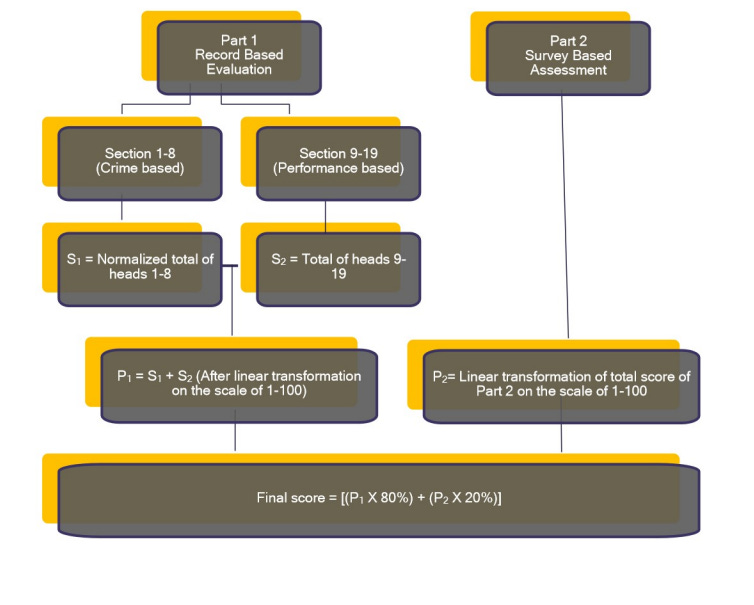
While the evaluation is of the shortlisted 77 police stations across 36 Indian states and union territories, the parameters are all personnel driven, infrastructure driven, quantitative and little to do with the quality of policing.
There is a strong case to be made to “invert” the entire methodology i.e. change the weightage for survey based assessments in the final score from a mere 4% to 80%.
#2 Third Man Check
Investigation calls for building a hypotheses of what happened with little evidence to help along. The greatest challenge in this process is when there is very little feedback to be offered to investigative officers on their theories. In a macabre way, an investigative officer is a researcher, and he is building a model of the “crime”. Elsewhere in the world, in other domains where researchers are expected to build models, there is a separation between the “developer” and the “validator”. This was historically served by the Office of a Public Prosecutor.
But India lacks one. Can this office be “simulated” by a very dirty proxy through another policeman? I argue yes. The chargesheets can be presented to the Station-in-Charge of a neighboring police station. The expectation is a second review by a person removed from the incentives and pressures of solving a case can offer valuable feedback. Can this be gamed? It can devolve into an oft seen behavior of “you-scratch-my-back-I-scratch-yours”, but it may be intermediated by the judicial system itself before a case is admitted.
I argue, that it will still be better than no-check, even though it is the same arm of the State verifying its own work.
An Alternative
A Study of Acquittals in Andhra Pradesh for the year of 20126 recommended hiring of legal officers(LO) to join investigations along with IOs, so that police personnel could continually confer with him during the investigation lifecycle. In case, hiring LO is not feasible, the study recommends provision to continually consult with the prosecutor.
#3 Independence of Department of Prosecution
Section 25A, 2005 Ammendment to the Code of Criminal Procedure, 1973 (Code) lays out the establishment of a Directorate of Prosecution under the administrative control of the home department of the state governments. However, it still does not allow for the level of functional autonomy required for public prosecutors to execute their role optimally. Where must it ideally sit? I argue, that it should be a state level Constitutional body, much like State Election Commission.
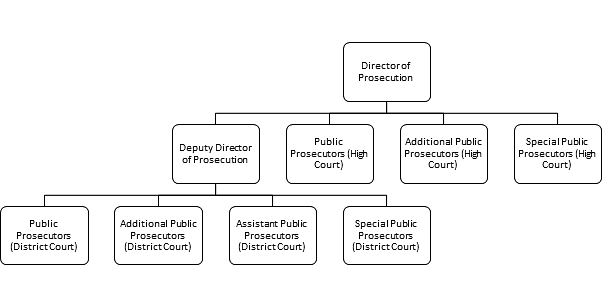
But that aside - Smriti Parsheera7 offers a deep dive into possible routes and pathways that a state can adopt (prosecution falls under State list), to deepen the independence of their prosecution departments. They include, a 50:50 split as per tenure and cadre; a dedicated budget, and due process of appointment and dismissal.
Is there a nudge that we can give to the individual states to transition along this path? I offer two micro-interventions:
Measure: Much like ASER-Pratham surveys, statistically minded policy groups must start their own ranking systems to evaluate individual state departments of prosecution.
Pressure: The Policing Community and the Civil Society both have a vested interest in building a successful prosecution department. This flies on the face of our understanding of conventional public choice theory - but acquittals reflect poorly in individual policemen’s records, and lay waste to their entire effort. There is a considerable scope for partnership between civil society and policing community in shifting the Overton window on this matter.
Final Words
These are tough problems. These are mindboggling problems. Dispensing justice is a mean business, and tightening the process requires a lot of understanding about how our police works. Policing in particular, is also an intermediate product in the lifecycle of justice delivery. In India, public officials work slightly differently. While public choice theory is an unassailable starting point, we often find the attitudes of officials in positions that matter - to be less self-serving. That offers us hope that there are people out there thinking about it as well.
The Pinkness of Jaipur

“Until you make the unconscious conscious, it will direct your life and you will call it fate.”
-purportedly C.J. Jung
Each of us carry a mental scaffolding with which we analyse and draw conclusions about the reality. This scaffolding is shaped by our genetic and social programming through sub-conscious acts of parental, social and peer-censure.
In our initial years, our environment allocates considerable resources to shape this mental framework. What we understand as education, acculturation or manners, form this programming. For the rest of our lives we follow a click-whirr behavior, a set of social responses that are consistent under similar context for a specific species (see fixed action pattern responses). We add features, and erect buildings and create grand fixtures around these scaffolds, yet never pause to question them. Thus resulting in a confusing mish-mash of inconsistent stances, and knee-jerk reactions as we respond to real life challenges.
In the absence of methodical deconstruction and principle-driven value system we will be forever driven by accidents of our culture. Akin to marionettes pulled by decayed men across dead centuries, we shall keep dancing to the singsong of old meanings and lost purposes.
A first principles based value system becomes our responsibility and a moral-aesthetic imperative. To the extent that our actions influence the life course of those dependent upon us, a self-culture becomes a moral-aesthetic exigency. The wisdom that we culture, the values we nurture and the actions we reward also have the ability, to reach across the chasms of generations in the future. How we see the world, and how we see ourselves in it have the ability to determine life courses.
First Principles Driven Value System, Looking Glass Self and Internal Scorecards
In absence of an internal anchor, we are subject to the vagaries of other’s judgements. We see ourselves the way we see others interprete us. Yet, in the precense of a unyielding anchor, we lose sight of ourselves.
This poses a dichotomy. Like most things in life, a balance is called for. On one hand the anchor cannot be so light that our ideas waver at the slightest change in popular currents. Yet, cannot be so heavy that we cannot roll it back and reinvent our identity.
Perhaps we need a compass, not an anchor; a North star of principles that will remain firm, unchanging and fixed; a mental map of our world, shaped by wisdom, and a navigation system of grit, gumption, and what ancients called sophos, to negotiate the crises of our lives.
The process of building this starts from a core foundational attitude - how much do we value other’s views? Warren Buffett, arguably the most successful investor in the world, asked to Alice Shroeder in her book Snowball, “Would you rather be the world’s greatest lover, but have everyone think you’re the world’s worst lover? Or would you rather be the world’s worst lover but have everyone think you’re the world’s greatest lover?” .
This is a more humorous way of putting through Buffett’s core idea, of having an internal scorecard vis a vis an external scorecard. The precense of an internal scorecard is expected to be an an accurate recordkeeping system stripped of signalling actions.
A downside to adopting such a conscious means of living is one will find herself in positions with contrarian viewpoints. At those times, having a first principles based rationale quells self-doubts.
Einstein’s Dreams and 120 year lifespan
Alan Lightman in his book Einstein’s Dreams, imagines worlds where time does weird things. In a world, it runs at different paces, at different places. In another, it runs in the opposite direction of entropy. In a still another, the time dilation is exaggerated in the absence of a gravitational field. The most interesting however is a particular ‘dream’, where people are immortal. They never die. So they are split in two groups with widely different philosophies. One group, called ‘Laters’ live life as it will never end. Languidly, slowly, maximizing the epicurean pleasures of life. After all - if a person’s life is of infinite length, is there a meaning to have an internal time-discount system at all? A benefit today is equivalent to a benefit tomorrow, and the preference function is ‘flat’ for them across years.
The other group, and more interesting group are the ‘Nows’. They live life as if they have infinite things to learn, infinite careers to build, infinite wisdom to attain and infinite love to love. They breeze through life because they are constantly in hurry, and they are constantly in hurry because they are constantly trying to learn.
It is an interesting thought experiment, and particularly important for the discussion,the two gentlement in the episode hold. Shah argues that Indians will have 100+ years of productive life, and it is imperative that we conduct ourselves like we have much wisdom to gain, much knowledge to attain, much more to experience. In that context it also becomes important that we nurture our own multitudes. That implies we constantly chisel away aspects of our ill-formed personas and build new ones.
A flip side is also that with longer lives, we will be more exposed to newer vagaries. We will meet novel crises. We will be faced with bigger problems. Even though navigating them will pose a challenge, successfully meeting them will open up riches. Acquiring wisdom, thus assumes its own importance.
I argue that there is a lot more benefit to be reaped by becoming ‘wiser’ now than in a world when we lived shorter lives, our economies were closed and our crises were harder to profit from. As our economy is exposed to freedom, there is variance “injected” in our lives. This “variation” exposes us to evolving opportunities and the wisdom to recognise and ride such tides can change one’s destiny. There is much truth to be found in the old Shakespearean line - “there are tides in the affairs of men, which taken at the flood leads on to fortunes; Omitted, all the voyage of life is bound in shallows and miseries.”
Begin Again?
Too often we become defined by a niche that we find ourselves in(by accident or by design). The niche becomes our identity and our multitudes are silenced under the burden of our identity. A successful quant risk consultant starts seeing himself as just that, and silences the philosopher in himself. A successful entrepreneur smothers the voice of art and music in herself. An established young adult fantasy fiction writer puts her dream of writing crime thriller to rest. I am fascinated by the idea if we can begin again. Can we give up our successes and recreate our identities again in a completely new field? Once we do that, can we then do it again? And then again?
We are constrained by our neuroplasticity (or lack thereof) and sense of complacency. Late-40s is a terrible age. We are stepping into the last phase of our professional careers, without a well-formed identity that is de-coupled from our professions. Can we overcome our own self-image and build something anew? I don’t have an answer, but I do have a few lines to leave for you.
If you can make one heap of all your winnings,
And risk it on one turn of pitch-and-toss,
And lose, and start again at your beginnings
And never breathe a word about your loss;
If you can force your heart and nerve and sinew
To serve your turn long after they are gone,
And so hold on when there is nothing in you
Except the Will which says to them: ‘Hold on!’
- If, Rudyard Kipling
Edits: This piece is reformatted for ease of vertical reading, edited for typos and lightly re-worded for clarity
References
Everything is Everything. 2023. “Are You Just One Version of Yourself? | Episode 3 | Everything Is Everything.” YouTube. July 14, 2023.
K.V.K, Santhy. 2012. “Problems in the Criminal Investigation with Reference to Increasing Acquittals: A Study of Criminal Law and Practice in ANDHRA PRADESH .” BPR&D. (link)
Ibid
Sinha P., Bhuvneshwar. 1960. K.M. Nanavati vs The State Of Bombay. 1961 AIR 112, 1961 SCR (1) 497.
Ministry of Home Affairs. 2024. “Ranking of Police Stations, 2024.” Ministry of Home Affairs. (link)
Ibid
Parsheera, Smriti. 2025. “Reforms of Prosecution in the Indian Criminal Justice System.” Theleapjournal.org. August 7, 2025. https://blog.theleapjournal.org/2015/05/reforms-of-prosecution-in-indian.html.
First time offenders become repeated offenders because how emboldening the system is for them